Fewer than a third of superyachts offer their crew any meaningful support (or at least what the crew consider to be meaningful), and in my experience the ones that don’t are most likely to be the ones that should be considering it. That’s a bit of a sweeping statement, granted, and there are always outliers.
Take a junior crew member in their first season, keen to impress their HOD. The last thing they’re going to do is admit they’re struggling, because in their head that looks weak and weak gets you replaced. So they keep it to themselves, get through the season, and then quietly tell their mates yachting wasn’t for them. As an industry we lose potentially good crew that way all the time, and more often than not, nobody onboard even clocked there was a problem.
If you’re a crew member reading this, the one thing worth saying is that finding it hard doesn’t mean you’re not cut out for the industry. The conditions are genuinely tough. The crew who go on to have long careers aren’t the ones who never struggled, they’re the ones who had somewhere to take it when they did.
I often talk to Captains about crew welfare and how it feeds into retention, and crew turnover costs significantly more than most expect. The trouble is you can’t always see it on the line of the budget where it actually lands.
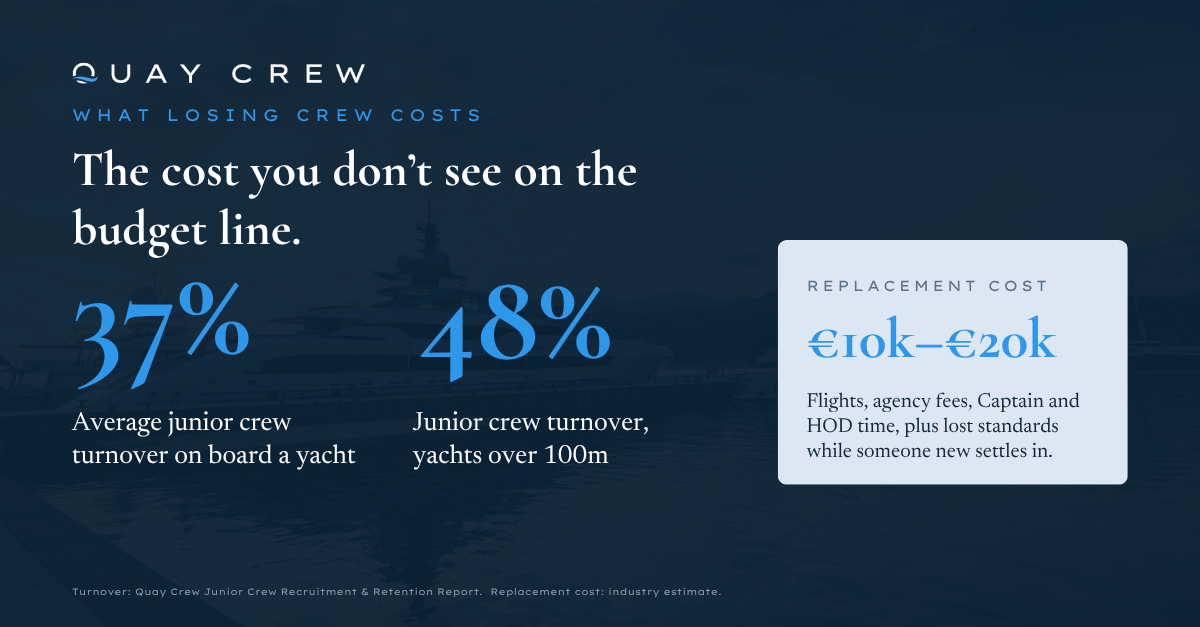
Junior crew turnover: The average turnover of junior crew annually onboard a yacht is 37%. This rises to as much as 48% on yachts over 100m. Replacing a crew member will typically set you back somewhere between €10k and €20k once you’ve factored in things like flights, Captain time, HOD time, agency fees, uniform etc and the dip in standards while the new person finds their feet. The more senior they are, the higher that figure climbs and the bigger the knock-on effect onboard.
There’s a reputation angle too. It’s a small industry and word gets around fast. A yacht that burns through crew earns itself a reputation very quickly, and the best candidates will simply withdraw their applications once it comes up in their due diligence, or after a quick look at Yachtie Name and Shame. The talent pool for good crew is small, and being known as a tough boat with really high turnover becomes a significant problem pretty quickly, which carries a genuine commercial risk if you’re running a successful charter yacht.
The good news is that none of what the better yachts do is particularly complicated or expensive. They put something in writing that crew can actually point to, rather than burying it in a handbook nobody opens, so a struggling Deckhand knows from day one where to go. And they train at least one person properly as a Mental Health First Aider, because whether someone speaks up early or sits on it until it boils over usually comes down to whether there’s an obvious, approachable person to talk to.
In my opinion the best approach is to have a shoreside company supporting you, the likes of MHSS Mental Health Support Solutions or Safe Haven, or someone along those lines, so there’s a qualified professional crew can reach confidentially, which matters most during the stretches when getting off the boat just isn’t an option. I’d take it a step further too: when you bring external support in, or when a new crew member joins, have everyone do an hour-long video call with one of the team at that company, so the relationship’s already there before anyone actually needs it.
These also fix the simple stuff that makes a difference. Starlink for the crew so they’ve got good wifi 24/7. Boat-led fitness sessions and run clubs. A chef putting out healthy food daily. Downtime whenever it’s possible during the season.
| What the better yachts put in place | Why it works |
|---|---|
| A written, visible support policy | Crew know where to go from day one |
| A trained Mental Health First Aider | An approachable person to talk to before it boils over |
| Confidential shoreside support (e.g. MHSS, Safe Haven) | A professional crew can reach when getting off the boat isn’t an option |
| Good wifi / Starlink | Crew can actually reach home |
| Fitness sessions, run clubs, healthy food | The daily basics that hold people up |
| Real downtime and rotation | Recovery, not just the promise of it |
It needs to be part of the culture, not just a one-off briefing in the yard. HODs regularly addressing how their people are in one-to-ones, and not just the work side of it, actually asking how someone’s feeling, probing a bit, and listening to the answers. Regular training sessions, and getting the crew to attend webinars together. Make it part of the values of the boat, and part of the recruitment process: this is the culture onboard, this is what we encourage, this is what we want. For this to work, captains and all HODs obviously need to be aligned.
Ultimately, a yacht that builds a supportive environment, one that encourages transparency and honesty, will reduce its turnover, save money, and provide a better service to the principal.
If you’re a Captain, owner or owner’s rep and you want to know what good actually looks like on a yacht your size, drop me an email at tim@quaygroup.com. I’m happy to talk through which programmes are getting this right, what they’ve put in place, and a few practical things you can do this season without needing a big budget conversation.
Support and resources
If you’re struggling, or you want somewhere to point your crew, these are good places to start.
ISWAN Yacht Crew Help: free, confidential, 24/7 helpline and mental health guides for yacht crew.
Sailors’ Society, Wellness at Sea: maritime welfare charity with a wellbeing programme, app and helpline support.
Nautilus International: welfare and mental health support for maritime professionals.
Mental Health First Aid England: where to train someone onboard as a Mental Health First Aider.
Samaritans: free, 24/7 emotional support for anyone in distress.
Mind: information and support on mental health.